
Understanding Hernias: Types and Who’s at Risk
A hernia is one of those conditions that people often notice visually before they notice it through pain, a bulge that appears somewhere it shouldn’t, sometimes only visible when standing, coughing, or straining. Because it can seem minor at first, especially if it isn’t painful, many people delay seeking evaluation. Understanding what’s actually happening beneath that bulge, and why it rarely resolves without intervention, helps explain why earlier evaluation generally leads to a better outcome.
What a Hernia Actually Is
A hernia occurs when an internal organ, or more commonly a portion of fatty tissue or intestine, pushes through a weakened area in the surrounding muscle or connective tissue wall that normally holds it in place. Most hernias develop in the abdominal wall, since this area contains several naturally weaker points, particularly where blood vessels or the spermatic cord pass through the muscle layers, or where surgical incisions have previously been made.
Think of the muscle wall as a container designed to hold internal structures securely in place. When a section of that wall weakens, whether due to a naturally thinner area, increased internal pressure, or previous surgical disruption, tissue can push through the gap, creating the visible or palpable bulge that’s the classic sign of a hernia.
The Main Types of Hernias
Inguinal hernias occur in the groin area and are by far the most common type, particularly in men. They develop through a naturally weaker point in the lower abdominal wall, an area related to the path the testicles took during fetal development, which leaves a slightly vulnerable area even in adulthood.
Umbilical hernias occur near the belly button, where the abdominal wall has a natural opening during fetal development that closes after birth in most cases. These are more common in infants, where the opening hasn’t fully closed, and in adults, particularly women who have had multiple pregnancies, since pregnancy places significant strain on the abdominal wall.
Incisional hernias develop at the site of a previous surgical incision, where the muscle wall may not have healed with its original strength, creating a vulnerable point that can weaken further over time, particularly with strain.
Hiatal hernias are a different category altogether, occurring when part of the stomach pushes up through the diaphragm into the chest cavity. These are often linked to symptoms of acid reflux rather than a visible external bulge, since the affected area is internal.
Femoral hernias occur just below the groin crease and are more common in women, particularly those who are pregnant or have given birth multiple times.
Who Is Most at Risk
Several factors contribute to the development of a hernia, generally by either weakening the abdominal wall or increasing the internal pressure placed against it:
✅ Heavy lifting, particularly when done with improper technique or without adequate core strength, places significant strain on the abdominal wall.
✅ Chronic coughing, often related to conditions like chronic bronchitis or long term smoking, repeatedly increases internal abdominal pressure.
✅ Obesity adds continuous strain to the abdominal wall and is associated with a higher likelihood of hernia development.
✅ Pregnancy, particularly multiple pregnancies, stretches and weakens the abdominal wall considerably.
✅ Prior abdominal surgery leaves an area of the muscle wall that, even after healing, may remain relatively weaker than surrounding tissue.
✅ Chronic constipation, due to repeated straining during bowel movements, increases internal pressure in a way that can contribute to hernia formation over time.
✅ A family history of hernias suggests some individuals may have naturally weaker connective tissue, making them more prone to developing one.
✅ Age related weakening of muscle tissue increases susceptibility, particularly for inguinal hernias in older men.
Recognizing the Signs
The presentation of a hernia can vary from barely noticeable to significantly uncomfortable, depending on its size, location, and how long it’s been present.
✅ A visible or palpable bulge is the most common and recognizable sign, often more noticeable when standing, coughing, or straining, and sometimes less noticeable or even absent when lying down.
✅ A feeling of heaviness, pressure, or mild aching in the affected area, particularly after physical activity or prolonged standing.
✅ Discomfort that worsens with lifting, bending, or straining, and improves with rest.
✅ In some cases, particularly with larger or longer standing hernias, a burning or aching sensation at the bulge site.
✅ For hiatal hernias specifically, symptoms often include heartburn, acid reflux, and occasionally difficulty swallowing, rather than a visible external bulge.
Not every hernia causes noticeable discomfort right away. Many people notice the bulge itself well before they experience any real pain, and it’s entirely possible to have a hernia for months without significant symptoms beyond the visible or palpable change.
Why Hernias Don’t Resolve on Their Own
Unlike some conditions that can improve gradually with rest or lifestyle adjustment, a true hernia represents an actual structural gap in the muscle wall. Once tissue has pushed through that gap, the opening itself doesn’t close or heal on its own, regardless of how much rest is taken or how carefully strain is avoided.
✅ The size of a hernia can remain stable for a period of time, but it often gradually enlarges as more tissue pushes through the weakened area, particularly with continued strain.
✅ Attempting to manage a hernia through activity avoidance alone doesn’t address the underlying structural defect, it simply reduces the immediate discomfort without resolving the actual problem.
✅ Because the opening tends to remain or even widen over time, most hernias, particularly once they’re causing any symptoms, eventually require surgical repair.
The Serious Risk of Strangulation
One of the most important reasons not to ignore a hernia, even a seemingly minor one, is the risk of strangulation, a genuine medical emergency.
✅ Strangulation occurs when the tissue that has pushed through the hernia opening becomes trapped and its blood supply is cut off.
✅ This is typically accompanied by sudden, severe pain at the hernia site, along with the bulge becoming firm, discolored, and often not able to be pushed back in as it might normally.
✅ Nausea, vomiting, and fever can accompany strangulation, along with the affected area becoming increasingly tender to touch.
✅ Without prompt surgical intervention, strangulated tissue can lose its blood supply long enough to become damaged beyond repair, which can be life threatening.
This risk, while relatively uncommon for any single hernia at any given time, is precisely why a diagnosed hernia isn’t something to simply monitor indefinitely without a clear plan, and why a sudden change in a previously stable hernia, particularly new severe pain or an inability to push the bulge back in, warrants emergency evaluation.
How Hernias Are Diagnosed
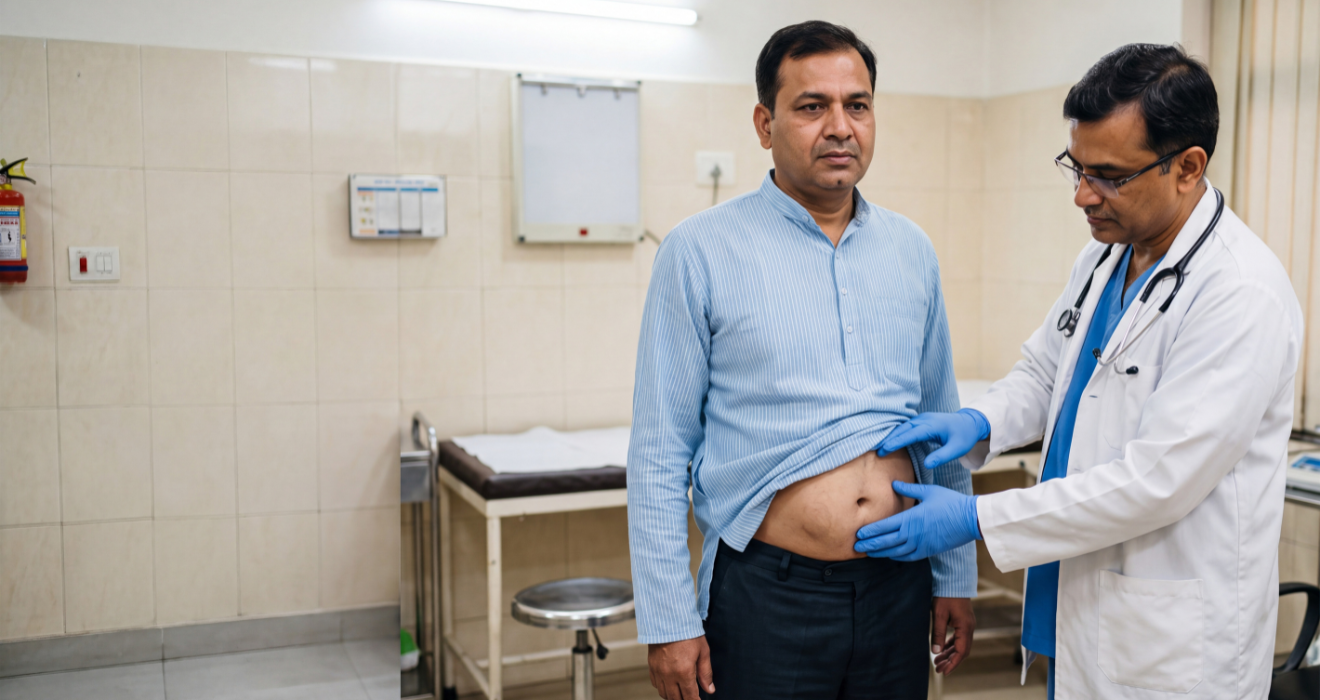
Physical examination is often sufficient on its own to diagnose a hernia, since the characteristic bulge, particularly when it becomes more prominent with coughing or straining, is a fairly distinctive finding.
Ultrasound imaging may be used to confirm the diagnosis, assess the size of the hernia, and determine what type of tissue has pushed through, particularly in cases where the physical exam findings are less clear.
CT scan, in some cases, particularly for more complex or larger hernias, or when there’s concern about complications, can provide more detailed information about the hernia’s exact location and contents.
Treatment Approaches
Watchful waiting is sometimes appropriate for very small, asymptomatic hernias, particularly in older adults where the risks of surgery might outweigh the relatively low risk of complication from a stable, minor hernia. This decision should always be made in consultation with a surgeon rather than independently.
Laparoscopic hernia repair is a common, minimally invasive surgical option, using small incisions and a mesh reinforcement to close the weakened area of the muscle wall securely.
Open hernia repair remains appropriate in certain cases, particularly for larger hernias, complex incisional hernias, or situations where laparoscopic access is not ideal.
✅ Both approaches aim to push the displaced tissue back into place and reinforce the weakened muscle wall, generally using a surgical mesh, to significantly reduce the likelihood of recurrence.
✅ The choice between laparoscopic and open repair depends on the hernia’s size, location, complexity, and the patient’s overall health profile.
✅ Recovery from laparoscopic repair is generally faster, with less post-operative discomfort and quicker return to normal activity, compared to open repair.
Life After Hernia Repair
✅ Most people are able to resume light activities within a week or two after laparoscopic repair, with full recovery, including a return to more strenuous activity, generally taking a few weeks longer.
✅ Following your surgeon’s specific guidance on lifting restrictions during recovery is important, since resuming heavy strain too early increases the risk of recurrence.
✅ Long term, the mesh reinforcement used in most modern hernia repairs significantly reduces, though doesn’t entirely eliminate, the chance of the same hernia recurring in the future.
✅ Addressing modifiable risk factors, such as achieving a healthy body weight or managing chronic cough, can further reduce the likelihood of developing a new hernia elsewhere.
Common Misunderstandings About Hernias
Misunderstanding: A hernia will go away if you avoid heavy lifting. As explained above, the structural opening itself doesn’t close through activity avoidance alone.
Misunderstanding: Only physically active people or manual laborers get hernias. While heavy lifting is a risk factor, hernias can develop in anyone with a naturally weaker area of the abdominal wall, including from causes like chronic coughing or previous surgery, unrelated to occupation.
Misunderstanding: A hernia is always painful. Many hernias, particularly smaller ones, cause no significant pain at all, especially in the earlier stages, which is part of why some people delay seeking evaluation.
Misunderstanding: Surgery is only necessary once a hernia becomes an emergency. Waiting until a hernia becomes strangulated turns a planned, controlled procedure into an emergency operation with higher risk. Addressing a diagnosed hernia proactively, before complications arise, is generally the safer and more straightforward path.
When to Seek Medical Attention
✅ Any new bulge noticed in the abdomen or groin, particularly one that becomes more prominent with straining or coughing
✅ Discomfort or heaviness at the site of a known hernia that seems to be increasing
✅ Sudden, severe pain at a hernia site, especially if the bulge becomes firm, discolored, or can no longer be gently pushed back in, which requires emergency evaluation
✅ Nausea, vomiting, or fever accompanying hernia related pain
A hernia represents an actual structural gap in the muscle wall, one that doesn’t resolve through rest or activity avoidance and carries a real, if uncommon, risk of a serious complication if left unaddressed indefinitely. Recognizing the type of hernia you may be dealing with, understanding your personal risk factors, and pursuing evaluation once a bulge or related discomfort appears puts you in a far better position than waiting to see what happens. A hernia rarely resolves on its own, so a visible bulge or persistent groin discomfort is worth a surgical evaluation sooner rather than later. Kamla Hospital’s General & Laparoscopic Surgery department is on Main Pataudi Road, Sector 37D, Gurugram.