Jaundice in Newborns: When It’s Normal and When It’s Not
Few things unsettle new parents quite like noticing a yellowish tint to their newborn’s skin in the first days of life. It’s an unfamiliar sight, and the instinct to worry is completely understandable. The reassuring truth is that jaundice is extremely common in newborns and, in the majority of cases, resolves on its own without any lasting effect. But understanding the difference between the ordinary version and the version that needs prompt medical attention matters, since a small proportion of cases do require intervention to prevent more serious complications.
What Causes Jaundice in Newborns
Jaundice occurs when there’s a buildup of bilirubin, a yellow pigment produced when the body breaks down old or excess red blood cells, in the bloodstream. In adults, the liver efficiently processes and removes bilirubin from the body. In newborns, particularly in the first several days of life, the liver is still maturing and isn’t yet fully efficient at this task, which allows bilirubin to accumulate temporarily and cause the characteristic yellowing of the skin and the whites of the eyes.
This process is compounded by the fact that newborns are born with a higher concentration of red blood cells than they’ll need going forward, since these cells were necessary for oxygen transport in the womb. As these excess cells break down naturally after birth, the resulting bilirubin adds to the load the immature liver needs to process, contributing further to the temporary buildup.
Why Most Newborn Jaundice Is Completely Normal
The kind of jaundice most newborns experience, often called physiological jaundice, follows a fairly predictable and reassuring pattern:
✅ It typically appears after the first twenty four hours of life, usually becoming noticeable on the second or third day.
✅ It tends to peak around the third to fifth day of life before gradually beginning to fade.
✅ In most cases, it resolves entirely on its own within one to two weeks without any treatment at all.
✅ It’s more common in breastfed babies and in babies born slightly early, though it can occur in any newborn.
✅ Mild physiological jaundice doesn’t typically cause the baby to appear unwell otherwise, meaning feeding, alertness, and overall behavior remain largely normal.
This pattern reflects a temporary mismatch between bilirubin production and the newborn liver’s still developing capacity to process it, a mismatch that resolves naturally as the liver matures over the first couple of weeks of life.
When Jaundice Signals Something That Needs Attention
While the majority of newborn jaundice fits the pattern described above, certain signs shift the situation from routine and expected to something requiring prompt medical evaluation:
✅ Jaundice that appears within the first twenty four hours of life, rather than the more typical second or third day, is considered more concerning and needs prompt evaluation, since early onset can indicate a more significant underlying cause.
✅ Jaundice that appears unusually intense or spreads rapidly, particularly if it extends beyond the face and chest to the arms, legs, and soles of the feet.
✅ Jaundice that persists beyond the typical one to two week window without improvement.
✅ A baby who seems unusually difficult to wake, is feeding poorly, or seems excessively sleepy or lethargic alongside the jaundice.
✅ High pitched crying, arching of the back, or unusual stiffness, which can be signs of significantly elevated bilirubin affecting the nervous system.
✅ Pale colored stools or notably dark urine, which can sometimes indicate a liver related cause beyond ordinary physiological jaundice.
The distinction between the two patterns isn’t always something a parent can determine with complete confidence at home, which is exactly why regular monitoring during the newborn period, particularly in the first week, is built into standard postnatal care.
Why Bilirubin Levels Are Monitored So Closely
The concern with jaundice isn’t the yellow color itself, which is a harmless visual marker, but what significantly elevated bilirubin levels can do if they rise too high or persist for too long.
✅ Very high bilirubin levels can cross into the brain and, in rare but serious cases, cause a form of brain damage called kernicterus, which can result in long term neurological complications.
✅ This risk is precisely why healthcare providers monitor bilirubin levels closely during the first days of life, particularly in babies who show risk factors for more significant jaundice.
✅ Monitoring allows treatment to begin well before bilirubin reaches levels associated with this serious complication, which is why the vast majority of newborns with even more significant jaundice never experience any lasting harm.
Risk Factors for More Significant Jaundice
Certain babies are more likely to develop jaundice that requires closer monitoring or treatment:
✅ Premature babies, since their livers are even less mature than those of full term infants.
✅ Babies with blood type incompatibility with their mother, which can cause more rapid breakdown of red blood cells.
✅ Babies who are exclusively breastfed and not feeding frequently enough in the early days, since inadequate feeding can slow the elimination of bilirubin through stool.
✅ Babies with bruising from a difficult delivery, since bruised tissue breaks down and releases additional bilirubin into the bloodstream.
✅ A sibling who previously had significant jaundice as a newborn, suggesting a possible family pattern.
✅ Certain genetic conditions affecting red blood cells or liver enzyme function, though these are less common causes overall.
How Newborn Jaundice Is Assessed and Diagnosed
Visual assessment. Healthcare providers routinely check newborns for signs of jaundice during hospital stays and follow up visits, examining the skin and the whites of the eyes under good lighting.
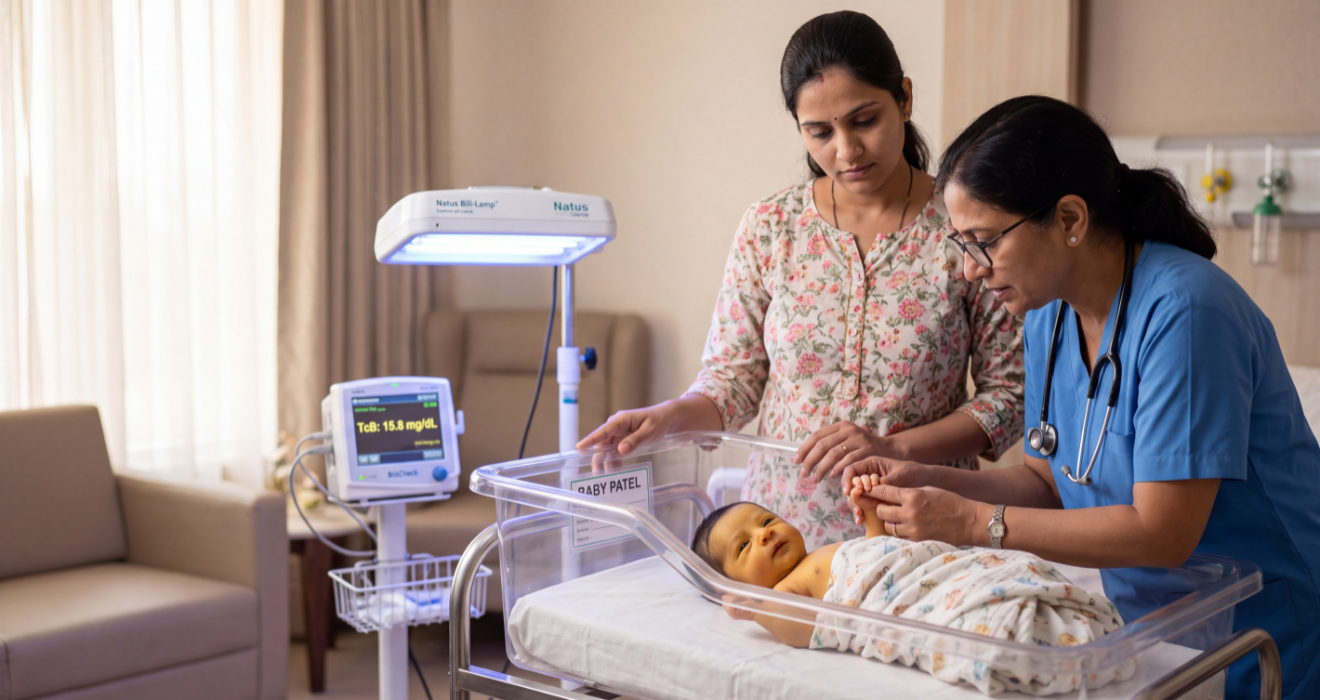
Transcutaneous bilirubin measurement. This involves a simple, painless device placed against the baby’s skin that estimates bilirubin levels without requiring a blood draw, often used as an initial screening tool.
Blood test for bilirubin levels. When more precise measurement is needed, particularly if the transcutaneous screening suggests elevated levels, a small blood sample is taken to measure bilirubin directly and track how it’s trending over time.
Additional testing, when needed. In cases where jaundice appears earlier than expected, is more severe than typical, or doesn’t follow the usual resolution pattern, additional blood tests may be ordered to investigate underlying causes, such as blood type incompatibility or other conditions affecting red blood cell breakdown.
How Newborn Jaundice Is Treated
Frequent feeding is often the first and simplest recommendation, since feeding stimulates bowel movements, which is the primary way bilirubin is eliminated from the body. Encouraging frequent breastfeeding or, when needed, supplementing appropriately under medical guidance helps support this process.
Phototherapy is the standard, highly effective treatment for jaundice with elevated bilirubin levels. It involves placing the baby under special blue spectrum lights, which help break down bilirubin in the skin into a form that can be more easily eliminated from the body.
✅ Phototherapy is generally safe, well tolerated, and doesn’t involve any needles or discomfort for the baby.
✅ The baby is usually undressed except for a diaper and protective eye covering during treatment, to allow maximum skin exposure to the light.
✅ Treatment duration varies depending on the bilirubin level and how quickly it responds, ranging from several hours to a couple of days in most cases.
✅ Bilirubin levels are rechecked periodically during treatment to track progress and determine when it’s safe to stop.
Exchange transfusion, a more intensive treatment involving gradually replacing the baby’s blood with donor blood, is reserved for the rare cases where bilirubin levels rise to a dangerously high level despite phototherapy, or when there’s a rapid, significant rise that needs urgent intervention.
What Parents Can Do at Home
For babies with mild jaundice being monitored rather than actively treated in a hospital setting, a few practical steps support recovery:
✅ Feeding frequently, generally every two to three hours, helps support bilirubin elimination through regular bowel movements.
✅ Watching for adequate wet and dirty diapers, which is a good indicator that feeding is effective and bilirubin is being eliminated appropriately.
✅ Attending all scheduled follow up appointments in the days after discharge from the hospital, since these checks are specifically designed to catch any jaundice that’s progressing beyond the expected pattern.
✅ Observing the baby’s alertness, feeding behavior, and overall responsiveness, and contacting a doctor promptly if these seem to be declining alongside visible jaundice.
✅ Checking the baby’s skin color in natural daylight, if possible, since indoor lighting, particularly yellow toned lighting, can make it harder to accurately judge the degree of jaundice.
Common Misunderstandings About Newborn Jaundice
Misunderstanding: Jaundice means something is wrong with the baby. In the vast majority of cases, jaundice reflects a temporary, expected mismatch between bilirubin production and an immature liver, not an underlying illness.
Misunderstanding: Breastfeeding should be stopped if a baby has jaundice. In most cases, the opposite is true. Frequent breastfeeding actually helps eliminate bilirubin more effectively, and stopping breastfeeding is rarely recommended, and only under very specific medical guidance in particular circumstances.
Misunderstanding: Sunlight exposure at home is an effective treatment. While sunlight does contain some of the wavelengths used in medical phototherapy, achieving a therapeutic effect safely at home isn’t practical or reliable, and it carries risks like sunburn or temperature regulation issues for a newborn. Medical phototherapy under supervision remains the appropriate treatment when needed.
Misunderstanding: Once jaundice resolves, there’s no need to mention it in future medical visits. It’s worth noting in a baby’s health history, particularly if it required treatment, since this information can be relevant to future care.
When to Seek Prompt Medical Attention
✅ Jaundice appearing within the first twenty four hours of life
✅ Jaundice that appears to be worsening or spreading rather than improving after the first week
✅ A baby who is unusually difficult to wake, feeding poorly, or seems lethargic
✅ High pitched crying, unusual stiffness, or arching of the back
✅ Jaundice persisting beyond two weeks of age
Newborn jaundice is common enough to be considered a normal part of the early days of life for many babies, and the majority of cases resolve on their own without any lasting effect. The key is recognizing the difference between the expected, mild pattern and the signs that suggest bilirubin levels need closer monitoring or active treatment. Regular follow up during the first week of life is specifically designed to catch this distinction early. If your newborn shows signs of jaundice, prompt assessment gives peace of mind and ensures treatment starts early if it’s needed. Kamla Hospital’s NICU works directly alongside our maternity ward on Main Pataudi Road, Sector 37D, Gurugram.