
Osteoarthritis in the Knee: Causes and Early Management
Osteoarthritis of the knee is one of the most common joint conditions affecting adults, and it’s also one of the most misunderstood. Many people assume it’s simply a natural, unavoidable part of aging that has to be endured until it eventually requires surgery. In reality, while age is a major risk factor, the way osteoarthritis develops, and how much it eventually limits daily life, depends heavily on how early it’s recognized and managed.
What Happens Inside the Knee
The knee joint relies on a layer of smooth cartilage that cushions the ends of the thigh bone and shin bone, allowing them to glide against each other with minimal friction during movement. Osteoarthritis develops when this cartilage gradually wears down over time. As the cushioning thins, bones begin to move with more friction and less protection, which leads to inflammation, pain, and eventually changes in the bone itself, including the formation of small bony growths called osteophytes.
This process rarely happens overnight. It tends to unfold slowly across months and years, which is exactly why so many people ignore the earliest signs. A little stiffness after sitting for a while, or mild discomfort after a long walk, doesn’t feel urgent, so it’s dismissed as ordinary wear and tear rather than something worth addressing early.
Who Is Most at Risk
Osteoarthritis is most common with advancing age, but it’s far from exclusive to older adults. A number of factors can accelerate its onset or make someone more susceptible earlier in life:
✅ Age remains the single biggest risk factor, since cartilage naturally loses some resilience and repair capacity over time.
✅ Excess body weight significantly increases the mechanical load placed on the knee joint with every step, accelerating cartilage breakdown.
✅ A previous knee injury, including ligament tears or meniscus damage, even if it healed years earlier, raises the long term risk of developing osteoarthritis in that same joint.
✅ Occupations or activities involving repetitive kneeling, squatting, or heavy lifting place cumulative strain on the knee over years.
✅ A family history of osteoarthritis suggests a genetic component that can make some people more prone to cartilage breakdown than others.
✅ Muscle weakness around the knee, particularly in the quadriceps, reduces the joint’s natural shock absorption and stability.
It’s worth noting that osteoarthritis can affect one knee more than the other, especially when there’s a history of injury or uneven muscle strength between the two legs, so symptoms don’t always appear symmetrically.
Recognizing the Early Signs
Because osteoarthritis develops gradually, its early symptoms are often subtle enough to be brushed off. Recognizing them early is one of the most valuable things a person can do for their long term joint health.
✅ Morning stiffness that eases within about thirty minutes of moving around is a common and often overlooked early sign.
✅ A dull ache after periods of activity, such as walking, climbing stairs, or standing for extended periods, that improves with rest.
✅ A grinding, clicking, or crackling sensation during movement, sometimes felt as much as heard.
✅ Mild swelling around the knee, particularly after a day of increased activity.
✅ A gradual reduction in the knee’s full range of motion, noticed as slightly more difficulty fully bending or straightening the leg compared to before.
✅ Discomfort that worsens with certain movements, like descending stairs or rising from a low seated position.
These symptoms tend to build slowly and inconsistently at first, appearing after particularly active days and fading on quieter ones, which makes it easy to convince yourself nothing is seriously wrong. Over months, though, the pattern usually becomes more frequent and more persistent.
How Osteoarthritis Is Diagnosed
A proper diagnosis typically combines a physical examination with imaging and, occasionally, additional testing to rule out other causes of joint pain.
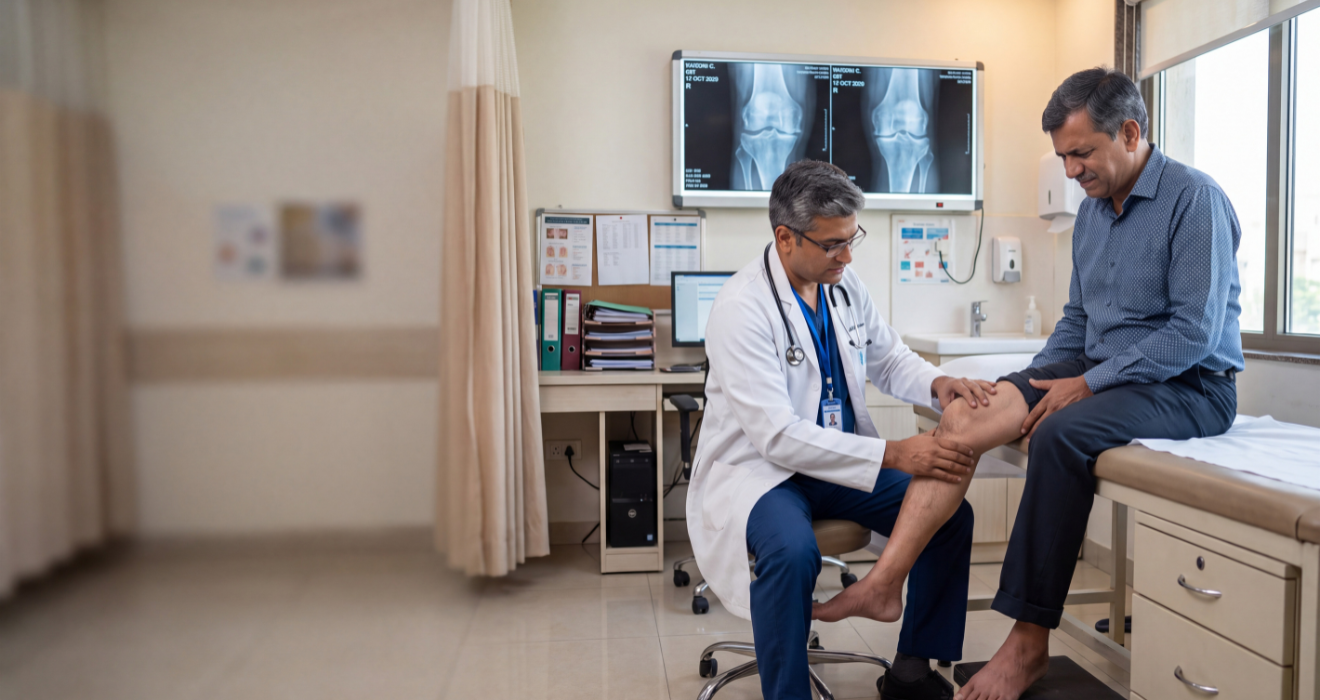
Clinical examination. The doctor will assess how the knee moves, check for tenderness along the joint line, look for any swelling or warmth, and evaluate the strength and alignment of the leg overall. They’ll also ask about the pattern of pain, when it started, what makes it better or worse, and how it’s affecting daily activities.
X ray imaging. This remains the standard way to visualize the joint space and identify hallmark signs of osteoarthritis, including narrowing of the space between the bones (which indicates cartilage loss) and the presence of bone spurs.
MRI, when needed. In cases where the picture isn’t entirely clear from an X ray alone, or where there’s suspicion of additional soft tissue damage like a meniscus tear, an MRI can provide a more detailed view of cartilage, ligaments, and surrounding tissue.
Blood tests, occasionally. These aren’t used to diagnose osteoarthritis directly, but they can help rule out inflammatory or autoimmune joint conditions, such as rheumatoid arthritis, that can present with somewhat similar symptoms.
Why Early Management Makes Such a Difference
Unlike a fracture or an acute injury, osteoarthritis doesn’t have a single fixed treatment path. Instead, it exists on a spectrum, and the range of effective, comfortable treatment options is far wider when the condition is caught early rather than after significant cartilage has already been lost.
At an early stage, many people respond very well to relatively simple, non surgical approaches:
✅ Structured physiotherapy focused on strengthening the muscles that support the knee, particularly the quadriceps and hamstrings, which reduces the load carried directly by the joint itself.
✅ Weight management, since even a modest reduction in body weight meaningfully reduces the pressure placed on the knee with every step.
✅ Low impact exercise, such as swimming, cycling, or walking on softer surfaces, which keeps the joint mobile without the repetitive high impact stress of activities like running.
✅ Anti inflammatory medication, used appropriately, to manage pain and swelling during flare ups.
✅ Supportive measures like knee braces or appropriate footwear, which can improve alignment and reduce discomfort during daily activities.
✅ Activity modification, learning which movements or positions tend to aggravate the joint and adjusting daily habits accordingly, without necessarily giving up meaningful activity altogether.
By contrast, once cartilage loss becomes advanced, these same conservative measures tend to offer less relief, and the conversation often shifts toward more significant interventions, including joint injections or, eventually, surgical options like partial or total knee replacement.
What Happens If Early Symptoms Are Ignored
It’s tempting to push through mild knee discomfort, especially since it often doesn’t interfere dramatically with daily life at first. But ignoring early symptoms tends to set off a cycle that makes things harder to manage later:
✅ Continued strain on a joint with early cartilage wear accelerates further breakdown, since the mechanical protection that healthy cartilage provides continues to erode.
✅ Pain often leads people to unconsciously reduce activity, which in turn weakens the surrounding muscles that would otherwise help stabilize and protect the joint.
✅ Reduced muscle support further increases the load carried directly by the joint surfaces, compounding the original problem.
✅ By the time the discomfort becomes significant enough to seek treatment, the range of effective non surgical options has often narrowed considerably.
This is precisely why persistent stiffness or recurring discomfort, even mild versions of it, deserves an orthopedic assessment rather than being written off as an inevitable part of getting older.
Living With Knee Osteoarthritis Day to Day
For people already managing a diagnosis, certain daily habits can meaningfully affect how the condition progresses and how comfortable everyday movement feels:
✅ Warming up gently before exercise and stretching afterward helps maintain flexibility and reduces stiffness.
✅ Choosing supportive, well cushioned footwear reduces the impact transmitted through the knee with each step.
✅ Alternating between sitting and standing throughout the day, rather than remaining in one position for extended periods, helps prevent stiffness from setting in.
✅ Using stairs mindfully, such as leading with the stronger leg going up and the affected leg going down, can reduce strain during a movement that’s often particularly uncomfortable.
✅ Staying consistent with prescribed physiotherapy exercises, even once symptoms improve, helps maintain the muscle strength that protects the joint over the long term.
✅ Monitoring for changes such as increasing pain, new swelling, or a noticeable change in how the knee feels, and reporting these to a doctor rather than assuming they’ll pass on their own.
Addressing a Few Common Misunderstandings
Misunderstanding: Osteoarthritis only affects the elderly. While age is a major factor, people in their thirties and forties with a history of knee injury, excess weight, or physically demanding occupations can develop it earlier than expected.
Misunderstanding: Exercise makes osteoarthritis worse. The right kind of exercise, particularly low impact activity and targeted strengthening, actually helps protect the joint by improving muscle support and maintaining mobility. It’s prolonged inactivity, not appropriate movement, that tends to worsen outcomes.
Misunderstanding: Nothing can be done until surgery is needed. As outlined above, there’s a substantial range of effective management options available well before surgery becomes necessary, and many people manage the condition successfully for years using these approaches alone.
Misunderstanding: A clicking or grinding sound always means something is seriously wrong. While it’s worth mentioning to a doctor, occasional joint sounds without accompanying pain or swelling aren’t automatically a sign of significant disease on their own.
When to See an Orthopedic Specialist
Certain signs suggest it’s time to move beyond home management and seek a professional evaluation:
✅ Stiffness or discomfort that has been present, even mildly, for several weeks or longer.
✅ Pain that’s starting to limit activities you’d normally do without a second thought, like walking a moderate distance or climbing a flight of stairs.
✅ Swelling that doesn’t fully resolve with rest.
✅ A noticeable change in how the knee moves or feels compared to a few months earlier.
✅ Pain that’s disrupting sleep or requiring frequent use of over the counter pain relief just to get through the day.
Knee osteoarthritis is a gradual condition, but it isn’t one that has to be simply endured until it becomes severe. Recognizing the early signs, understanding the risk factors that apply to you personally, and pursuing management strategies like physiotherapy, weight control, and activity adjustment while the condition is still in its earlier stages can significantly change its long term trajectory. If knee stiffness or discomfort has been a quiet, growing presence in your daily life, an orthopedic assessment now offers far more options than waiting until the condition becomes advanced. Kamla Hospital’s Orthopaedics department is on Main Pataudi Road, Sector 37D, Gurugram.