
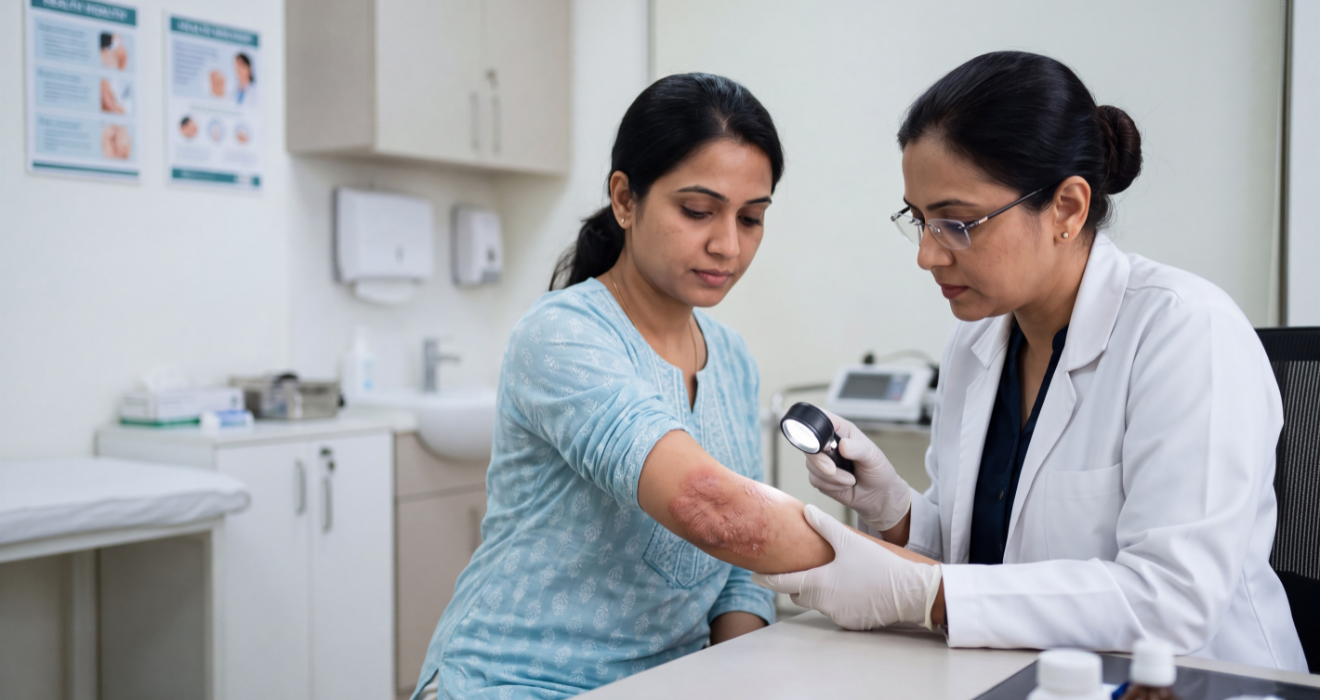
Eczema and Psoriasis: How to Tell Them Apart
Red, itchy, inflamed skin is one of those symptoms that can mean many different things, and eczema and psoriasis sit near the top of the list of conditions people confuse with one another. Both cause visible, uncomfortable skin changes, both tend to flare and settle over time, and both can affect confidence and quality of life significantly. But underneath the surface similarity, they’re driven by different biological processes, and that difference has real implications for how each one is treated.
What Eczema Actually Is
Eczema, sometimes called atopic dermatitis, is primarily driven by an overactive immune response, often in people who have a genetic tendency toward allergic or hypersensitive reactions. It’s frequently associated with a broader pattern known as the atopic triad, which includes eczema, asthma, and allergic rhinitis, suggesting that the underlying tendency toward immune overreaction runs across several body systems rather than being isolated to the skin alone.
Key characteristics of eczema:
✅ It commonly appears in the creases of the body, such as the inside of the elbows, behind the knees, the neck, and the wrists.
✅ Affected skin often looks red, dry, and cracked, and in more severe flares, it can appear weepy or oozing, especially if scratched repeatedly.
✅ Itching tends to be intense and is often the symptom that drives people to scratch, which in turn can worsen inflammation and increase the risk of skin infection.
✅ It frequently begins in childhood, though it can persist into adulthood or, less commonly, appear for the first time later in life.
✅ Flares are often triggered by specific irritants or allergens, including certain soaps, detergents, fabrics, extreme temperatures, and even emotional stress.
✅ Skin affected by eczema tends to lose moisture more easily than typical skin, which is why dryness is such a persistent underlying feature even between flares.
What Psoriasis Actually Is
Psoriasis, by contrast, is a chronic autoimmune condition, not an allergic reaction. In psoriasis, the immune system mistakenly speeds up the normal skin cell turnover cycle. Instead of skin cells maturing and shedding over roughly a month, they cycle through in a matter of days, causing an accumulation of cells on the skin’s surface that forms thick, scaly patches.
Key characteristics of psoriasis:
✅ It commonly appears on extensor surfaces, meaning the outer, more exposed parts of joints, such as the elbows, knees, lower back, and scalp.
✅ Patches, often called plaques, tend to look thicker and more clearly defined than eczema, frequently covered with a distinctive silvery white scale.
✅ The skin underneath the scale is often red and can bleed slightly if the scale is picked or scraped away, a feature sometimes referred to as pinpoint bleeding.
✅ Psoriasis can also affect the nails, causing pitting, thickening, or separation of the nail from the nail bed, a feature not typically seen with eczema.
✅ It’s associated with a broader condition called psoriatic arthritis in a meaningful percentage of cases, where joint pain and stiffness accompany the skin symptoms.
✅ Unlike eczema, psoriasis tends to persist as a lifelong condition, with periods of flare and remission rather than resolving on its own over time.
Where the Two Conditions Overlap
The confusion between the two is understandable, because several features genuinely do overlap:
✅ Both cause chronic, recurring episodes of red, inflamed skin.
✅ Both can be intensely itchy, though the itching pattern and intensity often differ.
✅ Both can flare noticeably during periods of high stress.
✅ Both have a genetic component, meaning a family history of either condition increases the likelihood of developing it.
✅ Both are considered chronic conditions that are managed over the long term rather than cured outright.
✅ Both can affect self esteem and emotional wellbeing, particularly when visible areas of skin are affected.
Given this overlap, especially in mild cases, it’s genuinely difficult to distinguish between the two by appearance alone, which is exactly why a proper dermatological examination matters more than searching for pictures online and trying to match them to your own skin.
Key Differences That Help Distinguish Them
While overlap exists, there are patterns that tend to point more clearly toward one condition or the other:
✅ Location on the body. Eczema favors the folds and creases, such as inner elbows and behind the knees, while psoriasis favors the outer surfaces of joints, the scalp, and the lower back.
✅ Texture and appearance. Eczema tends to look more raw, red, and sometimes weepy, while psoriasis tends to look thicker, more clearly demarcated, and covered with a distinctive scale.
✅ Age of onset. Eczema very often begins in early childhood, while psoriasis can appear at any age but frequently emerges in early adulthood.
✅ Associated conditions. Eczema is more closely tied to other allergic conditions like asthma and hay fever, while psoriasis is more closely tied to joint symptoms and a broader category of autoimmune conditions.
✅ Nail involvement. Nail changes are a more distinctive feature of psoriasis and are far less common in eczema.
✅ Response to moisturizing alone. Eczema often improves meaningfully with consistent, intensive moisturizing, while psoriasis, though it also benefits from moisturizing, typically needs more targeted treatment to control the underlying immune process.
How a Dermatologist Reaches a Diagnosis
A dermatologist typically relies on a combination of visual examination, patient history, and occasionally additional testing to confirm which condition is present.
Visual examination and history. The pattern, location, and appearance of the affected skin, combined with when it started, what makes it better or worse, and whether there’s a personal or family history of allergies, asthma, or autoimmune conditions, often gives a fairly clear picture on its own.
Skin biopsy, when needed. In cases where the appearance is ambiguous, a small skin sample can be examined under a microscope to identify the specific cellular changes characteristic of psoriasis versus eczema.
Assessment for associated symptoms. Since psoriasis can be linked to joint symptoms, a dermatologist may ask about joint pain, stiffness, or swelling, which could suggest psoriatic arthritis and warrant further evaluation.
Allergy assessment, when relevant. For eczema, especially in cases where a specific trigger is suspected, allergy testing may help identify substances to avoid going forward.
Why the Distinction Actually Changes Treatment
This is where the difference between the two conditions becomes practically important rather than just academically interesting.
Eczema treatment generally focuses on:
✅ Intensive, consistent moisturizing to repair and maintain the skin’s protective barrier
✅ Identifying and avoiding specific triggers, whether that’s certain fabrics, soaps, or environmental allergens
✅ Topical steroid creams to control inflammation during flares
✅ Antihistamines, in some cases, to help manage itching, particularly if it’s disrupting sleep
✅ In more severe or persistent cases, targeted immune modulating medications
Psoriasis treatment generally focuses on:
✅ Topical treatments, including corticosteroids and vitamin D analogues, that slow down the excessive skin cell turnover
✅ Phototherapy, a controlled form of light treatment that can meaningfully reduce plaque formation
✅ Systemic medications, including oral or injectable options, that target the underlying immune pathways driving the disease, generally reserved for more moderate to severe cases
✅ Regular monitoring for joint symptoms, given the association with psoriatic arthritis
✅ Long term management planning, since psoriasis tends to be a lifelong condition requiring an ongoing relationship with a dermatologist rather than a one time treatment course
Using an eczema focused treatment plan on someone with psoriasis, or vice versa, often produces limited or inconsistent results, which is part of why an accurate diagnosis at the outset saves considerable time, frustration, and unnecessary trial and error.
Managing Flares in Daily Life
Regardless of which condition is present, certain everyday habits tend to help reduce the frequency and severity of flares:
✅ Keeping skin consistently moisturized, ideally right after bathing while the skin is still slightly damp, to lock in hydration
✅ Using mild, fragrance free soaps and detergents that are less likely to irritate sensitive skin
✅ Avoiding excessively hot showers or baths, which can strip natural oils and worsen dryness
✅ Managing stress levels, since both conditions are known to flare during periods of high emotional or physical stress
✅ Wearing soft, breathable fabrics and avoiding rough or synthetic materials that can rub against affected areas
✅ Resisting the urge to scratch, since scratching tends to worsen inflammation and increases the risk of secondary skin infection
✅ Keeping a simple log of flare patterns, noting what seemed to trigger a flare up, which can help identify personal triggers over time
Common Misunderstandings Worth Clearing Up
Misunderstanding: Eczema and psoriasis are contagious. Neither condition is contagious. They cannot be spread through touch, shared items, or close contact.
Misunderstanding: These conditions are purely cosmetic issues. Both can cause genuine physical discomfort, disrupted sleep due to itching, and in the case of psoriasis, joint involvement that affects mobility, beyond the visible skin changes alone.
Misunderstanding: Diet alone can cure either condition. While certain dietary changes may help some individuals manage flares, particularly with eczema when a specific food trigger is identified, neither condition is resolved through diet changes alone without appropriate medical treatment.
Misunderstanding: Once it clears up, it’s gone for good. Both are chronic conditions prone to recurrence. A period of clear skin doesn’t necessarily mean the underlying tendency has disappeared, which is why ongoing skin care and, in many cases, maintenance treatment remain important even during quieter periods.
When to See a Dermatologist
Certain signs suggest it’s time for a professional evaluation rather than continuing to manage things with over the counter products alone:
✅ Persistent redness, scaling, or itching that hasn’t improved with basic moisturizing and home care after a couple of weeks
✅ Skin changes that are spreading or worsening despite consistent care
✅ Signs of possible infection, such as increased warmth, swelling, pus, or fever alongside the skin changes
✅ Nail changes, including pitting, thickening, or separation from the nail bed
✅ Joint pain or stiffness accompanying skin symptoms
✅ Skin symptoms significantly affecting sleep, confidence, or daily functioning
Eczema and psoriasis share enough surface similarity to confuse even attentive observers, but they stem from fundamentally different processes, an allergic type immune overreaction in the case of eczema, and an autoimmune driven acceleration of skin cell turnover in the case of psoriasis. Because their treatment approaches diverge meaningfully, getting an accurate diagnosis matters more than guessing based on how a rash looks or matching it to pictures found online. Kamla Hospital’s Dermatology department is available on Main Pataudi Road, Sector 37D, Gurugram.